The Sulfite Loophole in Organic Wine: What a 'Made With Organic Grapes' Bottle Lets Through
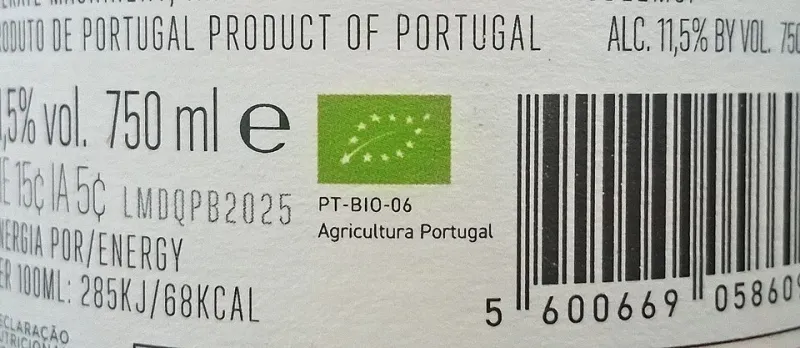
Photo: Jakub Wejchert, CC BY-SA 4.0, via Wikimedia Commons
You are standing in the wine aisle of a store that has clearly invested in nice shelving. A bottle catches your eye: cream label, cursive font, the words Made with Organic Grapes in green. It is $28. The bottle next to it says nothing about organic and costs $14.
It is entirely reasonable to assume the expensive one is the cleaner pour. It is also entirely possible that it contains more added sulfites than the cheap one.
This is not a scandal, exactly. It is a labeling system with three tiers, and the middle tier is the one most shoppers have never had explained to them.
Three claims, three different rulebooks
In the US, wine can carry an organic claim under the USDA's National Organic Program. There are three tiers, and they are not interchangeable.
'100% Organic.' Everything in the bottle is organically produced, with the usual exclusions for water and salt. No added sulfites are permitted. The USDA seal can appear on the label.
'Organic.' At least 95% of the ingredients are organic by weight, again excluding salt and water. No added sulfites are permitted. The USDA seal can appear here too.
The key detail in both of those tiers: grapes are grown organically and the winemaker is barred from adding sulfites during production. Whatever sulfites exist are the ones fermentation naturally creates.
'Made with Organic Grapes.' At least 70% of the ingredients are organic. This is where the hinge swings open — added sulfites are allowed, capped around 100 parts per million. And because the product falls below the 95% threshold, the USDA seal cannot appear on the label. You may see the certifying agent's own mark instead, which looks official without being the same thing.
For context, conventional wine can carry up to 350 ppm of total sulfites. So 'made with organic grapes' still lands well under the conventional ceiling. It just isn't zero-additive, and nothing on the front of the bottle tells you that.
Why 'contains sulfites' appears on almost everything
Any wine with 10 ppm or more of total sulfites has to declare it. Since fermentation itself produces sulfites in that range, nearly every bottle in the store carries the phrase — including wines with zero added sulfites. Seeing it does not mean someone dumped a scoop in.
That matters because most shoppers read 'contains sulfites' as a warning sign and the absence of it as a green light. In practice, the phrase tells you almost nothing about whether sulfites were added.
The headache problem
Sulfites get blamed for a lot. Headaches, flushing, next-morning misery. Some of that blame is misplaced.
True sulfite sensitivity is real, but it is not common — estimates cluster around 1% of the general population, and it shows up more often in people with asthma, where the reaction tends to be respiratory rather than a run-of-the-mill headache. For most people who feel rough after wine, the more likely culprits are alcohol itself, dehydration, histamines and other biogenic amines produced during fermentation, or tannins.
Here is a detail that trips people up: white wines usually carry more total sulfites than reds, because whites need more protection from oxidation. If red wine gives you a headache and white doesn't, sulfites are probably not your problem.
What the label still won't tell you
Even the strictest tier is a promise about grape growing and, at the top two levels, added sulfites. It is not a promise about winemaking style. Organic-certified wine can still be made with selected commercial yeasts, oak chips, and fining agents. It is not automatically 'natural wine,' and it is definitely not automatically low-intervention.
One more wrinkle for imported bottles: the EU has its own organic wine rules, and they do permit added sulfites under a lower cap. A French or Italian bottle labeled organic is following a different rulebook than a US bottle labeled organic. The word translates; the standard does not.
And if a bottle claims to be 'sulfite-free,' be skeptical. Given that fermentation produces sulfites, that claim is doing some interpretive dance.
A five-second read before you buy
- Find the tier phrase, not the grape. 'Made with organic grapes' and 'organic' are different products with different rules.
- Look for the USDA seal. If it's there, no sulfites were added. If it isn't, check which phrase is used.
- Ignore 'contains sulfites.' It's mandatory and near-universal. It's not a differentiator.
- Note who certified it. The certifier's name or logo means a real inspection happened, even at the 70% tier.
- Buy a glass before a bottle. Most wine shops and plenty of restaurants will pour a taste. At $30 a bottle, that's the cheapest insurance in the store.
The budget takeaway
If avoiding added sulfites is your goal, you do not need to spend more — you need to read the tier. Plenty of 'Organic' (95%) bottles sit in the $15 to $22 range, and they carry the same no-added-sulfite rule as the $28 one with the pretty label. Conversely, a $30 'made with organic grapes' bottle may have more additives than a $13 bottle that makes no organic claim at all.
Spend the premium if you want to support organic farming. Just don't assume the premium is buying you a cleaner glass. The label tells you which promise you're paying for — you just have to know which words to look for.